
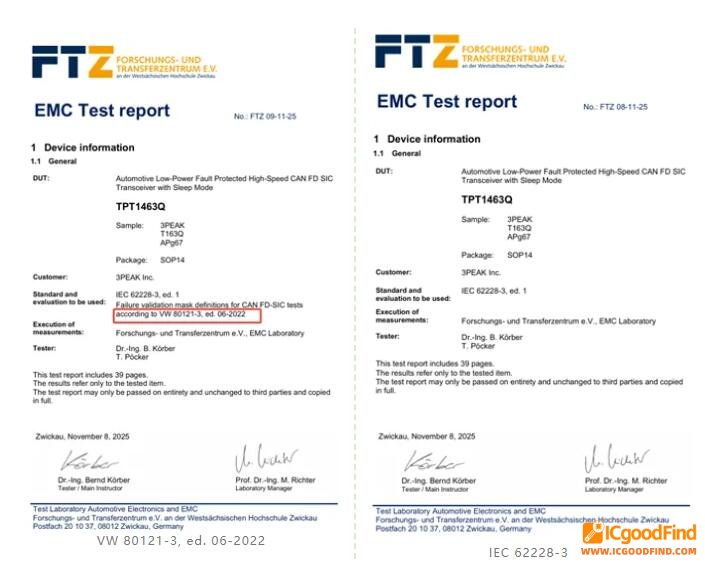
Amid accelerating vehicle intelligence and electrification, the CAN bus serves as the core neural network of a vehicle's electronic system, where data transmission stability is critical for driving safety. 3PEAK, a specialist in automotive chips, has launched the automotive-grade CAN transceiver TPT1463Q. With robust anti-interference design, it has achieved certification under the IEC62228-3 international standard and Volkswagen’s VW80121-3 specification, delivering a highly reliable, high-performance communication solution for global automakers.
Notably, the TPT1463Q is fully localized in its supply chain, ensuring autonomy and control. The wafer process relies on domestic mature automotive-grade platforms, with core materials and manufacturing sourced locally to avoid international supply chain volatility. Packaging is handled by leading domestic providers using automotive-grade solutions, offering both SOP14 and DFN14 package options—the DFN14 supports AOI inspection, balancing compact size with production reliability. Testing is conducted entirely by domestic labs with automotive electronic certification, ensuring performance meets vehicle-grade standards and shortening both R&D and mass production cycles. This localization not only strengthens supply chain security but also achieves cost reduction and efficiency gains through domestic industry collaboration, providing cost-effective and controllable options for local automakers.
Faced with complex electromagnetic environments due to the surge of electronic modules in vehicles, the TPT1463Q demonstrates outstanding EMC performance. Beyond meeting all IEC62228-3 requirements, it achieves Class-3 (highest level) compliance without special conditions under Volkswagen’s VW80121-3 (2023-12) CAN FD-SIC standard, covering four key test dimensions for automotive electromagnetic interference risks. Key metrics such as interference immunity and transient protection are set with higher thresholds, fully validating stable operation in complex automotive settings.
The superior EMC performance stems from innovative hardware design tailored for harsh automotive interference. It incorporates a bus symmetry adjustment circuit that optimizes output signal symmetry to reduce electromagnetic emissions, enabling compliance with vehicle EMC requirements without extra shielding—simplifying design, saving PCB space, and lowering system cost. Additionally, the product features a differential signal enhancement unit, balancing high-speed communication and strong noise immunity. In 2Mbps/5Mbps high-speed communication scenarios, it achieves high interference immunity without relying on common-mode chokes. During BCI (bulk current injection) testing, it maintains stable communication across 0.1–400MHz frequencies even under interference currents up to 200mA, saving peripheral component costs and PCB space while reducing failure risks and enhancing system reliability.
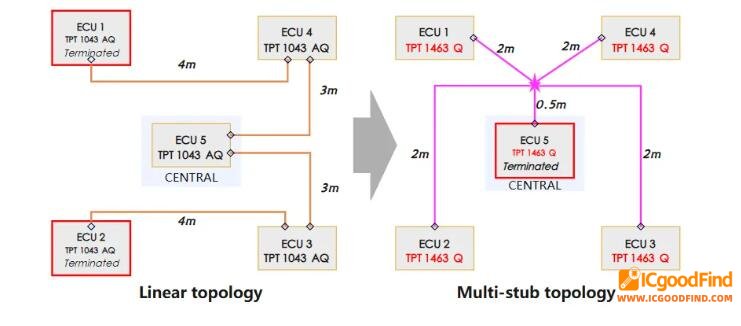
To ensure seamless vehicle bus interoperability, the TPT1463Q successfully passed C&S interoperability and compatibility testing (IOPT). In complex heterogeneous networking scenarios at 2Mbps/5Mbps speeds, it demonstrates excellent communication capability with international competitors, enabling seamless integration with upstream/downstream CAN bus devices without requiring extensive vehicle compatibility testing—significantly shortening vehicle development cycles. Leveraging SIC ringing suppression circuitry, the product effectively suppresses signal ringing in complex ringing network scenarios referenced by CiA 601-4 special tests, ensuring reliable data communication in noisy environments.
The CAN SIC function of the TPT1463Q employs precise circuitry to establish a complete ringing suppression mechanism. When ringing occurs as bus levels transition from dominant to recessive, the built-in circuit detects level edges in real time, quickly activates suppression modules, and dynamically adjusts bus levels to maintain signal integrity, significantly reducing bit error rates. This ensures high-speed, reliable CAN FD communication in complex topologies, addressing signal ringing issues in star topologies and high data rate scenarios.
Additional core advantages include:
Communication rates up to 10Mbps, exceeding the CAN FD standard of 5Mbps and meeting ISO11898 requirements for 8Mbps, with lower transmission delays suitable for high-data-volume applications like autonomous driving and infotainment.
Four operating modes (Normal, Standby, Listen-only, Sleep) to support new energy vehicle needs, with ultra-low power consumption in Sleep mode via INH control and support for remote bus wake-up or local KL15 signal wake-up.
Significantly reduced bit error rates through effective ringing suppression, ensuring stable performance of vehicle control systems under strong electromagnetic interference.
High networking flexibility, overcoming traditional CAN FD limitations and maintaining high-quality bus waveforms even in multi-node complex star topologies.
Wide supply voltage (VIO: 1.7~5.5V), directly compatible with various vehicle modules like MCUs and sensors without extra voltage conversion circuits.
ICgoodFind : The 3PEAK TPT1463Q leverages localization advantages and exceptional performance to deliver a superior solution for automotive CAN communication, helping automakers strengthen vehicle safety.
